Walk down a supermarket aisle or scroll through an online store, and you'll find dozens of filter coffee powders. Some say 80:20, some say "pure coffee", some say "French coffee", and most say "strong". So how do you pick the one that will taste right in your tumbler?
The best filter coffee powder is the one that matches how you like your kaapi. This guide explains what to look for on the pack, and helps you choose a blend you'll enjoy.
To choose a filter coffee powder, decide how much chicory you want (more chicory is milder and darker, less is bolder), then look for good beans, a medium roast, a grind made for the South Indian filter, and a recent roast date.
1. Decide on your coffee-chicory ratio
This is the biggest choice. Chicory is a roasted root that makes the decoction darker, thicker and smoother. It has no caffeine. The ratio on the pack tells you how much coffee and how much chicory is inside. Our coffee-chicory ratio guide goes deeper.
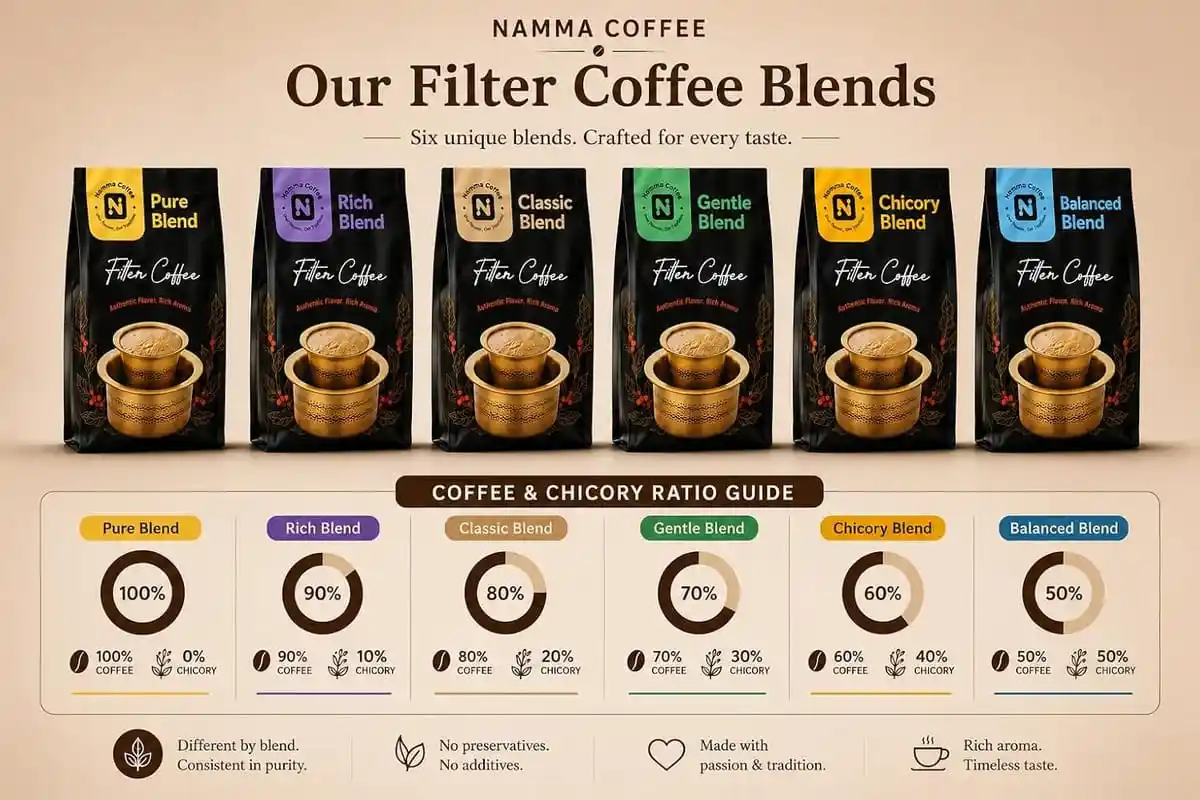
| Ratio (coffee : chicory) | What it tastes like | Choose it if you… |
|---|---|---|
| 100 : 0 | Bold, clean and aromatic | want pure coffee, or drink it with less milk |
| 90 : 10 | Strong, with a little extra body | like a strong cup but want some smoothness |
| 80 : 20 | Rich and smooth, the classic balance | want the traditional taste, or are new to filter coffee |
| 70 : 30 | Smoother and lighter | find 80:20 a little too strong |
| 60 : 40 | Deep colour, earthy, traditional | grew up with a strong chicory taste |
| 50 : 50 | Mild and easy | want low caffeine, or drink very milky coffee |
Not sure? Start with 80:20. It's the most popular ratio and the taste most people know as South Indian filter coffee. You can go stronger or milder from there.
2. Look at the beans
Most filter coffee blends combine two types of coffee:
- Arabica: aroma, smoothness and a slightly fruity flavour.
- Robusta: strength, body and a stronger "kick" that stands up to milk.
Some brands go further and name the grade of beans:
- Plantation A: a grade of washed Arabica with a clean, smooth flavour.
- Peaberry: small, round beans that grow one to a cherry instead of two, often described as brighter and sweeter.
A pack that tells you the beans and where they're grown is usually a good sign. Namma Coffee blends Plantation A, Peaberry and Robusta from Chikkamagaluru, Karnataka, where coffee was first grown in India.
3. Check the roast
For filter coffee, a medium roast is usually best. It gives a dark, rich decoction with a full body.
- Too light: the decoction can taste thin and sour with milk.
- Too dark: it can taste burnt and bitter.
"Extra strong" on a label often just means a darker roast or more chicory, not necessarily better coffee.
4. Make sure it's ground for the filter
Filter coffee powder should be a medium-fine grind, made for the South Indian filter.
- Espresso-fine powder blocks the holes, so the decoction drips very slowly and turns bitter.
- Coarse powder, like French press coffee, lets water run straight through and gives a weak decoction.
If you buy whole beans, ask for them to be ground for a South Indian filter.
5. Freshness matters more than the brand
Coffee starts losing its aroma soon after it's roasted and ground. Old powder gives a flat, dull decoction, however good the beans were.
- Look for a roast date or a recent packing date.
- Choose packs that seal well, like resealable or zip-lock pouches.
- Buy a size you'll finish in a few weeks. A 250 g pack suits most small households.
- At home, store the powder in an airtight container, away from heat, sunlight and moisture.
Namma Coffee roasts in small batches, and packs and dispatches every batch within 24 hours.
6. Match the powder to how you drink it
| How you drink filter coffee | Try |
|---|---|
| Strong, with less milk | 100:0 or 90:10 |
| The classic way, 1 part decoction to 3 parts milk | 80:20 |
| Light and milky, several cups a day | 70:30 to 50:50 |
| You want less caffeine | A higher-chicory blend, like 60:40 or 50:50 |
| You're buying for the whole family | 80:20, the safest choice |
Namma Coffee blends at a glance
| Blend | Coffee : Chicory | In one line |
|---|---|---|
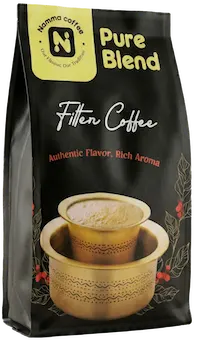
| Pure Blend | 100 : 0 | Pure coffee for a bold, authentic cup |
| Rich Blend | 90 : 10 | Rich coffee with a touch of chicory |
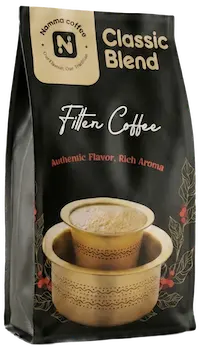
| Classic Blend | 80 : 20 | The classic South Indian balance |
| Gentle Blend | 70 : 30 | Smooth and lighter |
| Chicory Blend | 60 : 40 | Deep colour, traditional taste |
| Balanced Blend | 50 : 50 | Smooth and easy, for every day |
Getting the best from your powder
Even the right powder needs the right brew. The basics:
- Add 3–4 tablespoons of powder to the top of your filter and press it lightly.
- Pour in water just off the boil, close the lid and leave it for 15–20 minutes.
- Mix 1 part decoction with 3–4 parts hot, full-cream milk, and add sugar.
- Pour between the tumbler and davara until frothy.
For the full method and fixes for weak or bitter coffee, see how to make South Indian filter coffee.
What to eat with it: filter coffee goes perfectly with idli, dosa, vada, upma or pongal at breakfast, and with murukku, banana chips or Marie biscuits in the evening.
Frequently asked questions
Which is the best filter coffee powder?
It depends on your taste. For the traditional South Indian taste, an 80:20 coffee-chicory blend is the most popular choice. If you want pure coffee, choose 100% coffee; for a milder cup, choose a blend with more chicory.
Is filter coffee with chicory bad?
No. Chicory is a roasted root that has been part of South Indian filter coffee for generations. It adds body and smoothness and has no caffeine.
How much filter coffee powder should I buy?
Buy a pack you'll finish within a few weeks of opening, so the coffee stays fresh. For most households, 250 g is a good size.
Can I use filter coffee powder in a coffee machine?
It's ground for the South Indian filter, so it works best there. It can work in a French press or moka pot, but it's too fine for most drip machines with paper filters.
Still deciding? Start with the Classic Blend (80:20), the taste most people grew up with, or try the Pure Blend for 100% coffee with no chicory.