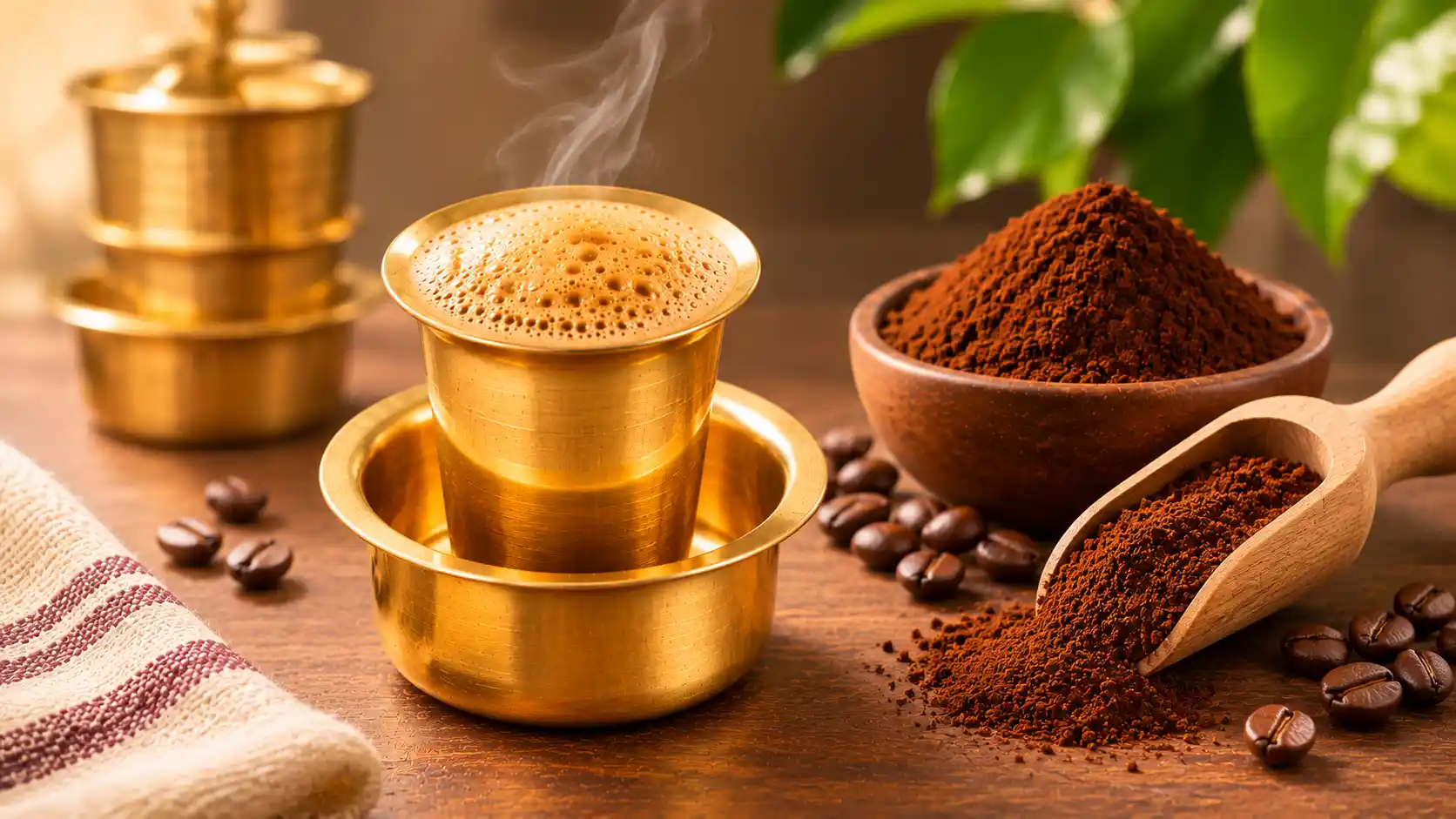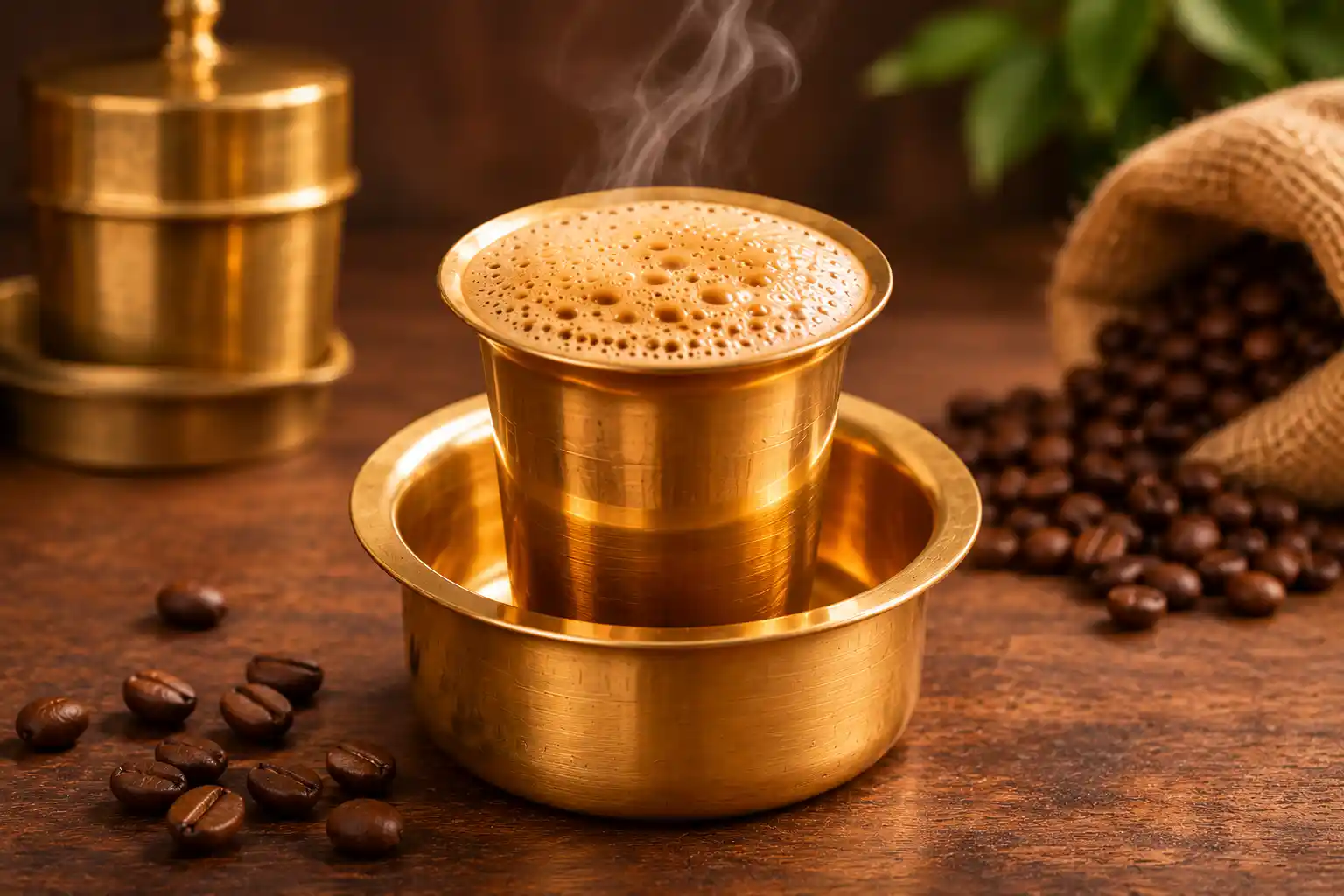
A frothy tumbler of filter coffee, steam rising from the davara, the newspaper on the side: for millions of South Indian homes, that's how the day begins. Good kaapi isn't complicated, but every step matters, from the coffee powder you buy to the way you pour.
This guide covers everything you need to make South Indian filter coffee at home: what to buy, how to brew the decoction, the right milk ratio, and how to fix a cup that tastes weak or bitter.
To make South Indian filter coffee, add 3–4 tablespoons of filter coffee powder to the top of a filter, pour in boiling water and let it drip for 15–20 minutes. Mix 1 part decoction with 3–4 parts hot milk, add sugar, and pour between a tumbler and davara to froth.
What you need
- A South Indian coffee filter (two stacked steel or brass chambers with a pressing disc)
- 3–4 tablespoons of filter coffee powder
- Freshly boiled water
- Full-cream milk
- Sugar, to taste
- A tumbler and davara (dabara) for serving
No filter? Line a fine sieve with a muslin cloth, place it over a bowl, and pour the water slowly over the powder. The decoction will be a little lighter, but it works.
How to make filter coffee, step by step
- Add the coffee powder Put 3–4 tablespoons of filter coffee powder into the upper chamber (the one with holes). Place the pressing disc on top and press lightly. Don't pack it hard, or the water won't drip through.
- Pour in boiling water Leave the disc in place and pour freshly boiled water over it, up to the brim of the upper chamber. Close the lid.
- Let the decoction drip Leave it for 15–20 minutes. The thick, dark coffee that collects in the lower chamber is the decoction. The first decoction is the strongest, so don't hurry it.
- Heat the milk Bring full-cream milk to a boil. Hot, freshly boiled milk gives the best taste and froth.
- Mix decoction and milk Pour 1 part decoction into a tumbler and add 3–4 parts hot milk. Use 1:3 for a strong cup and 1:4 for a milder one. Add sugar to taste.
- Pour and froth Pour the coffee between the tumbler and davara a few times, from a height, until a light froth forms on top. Serve hot in the tumbler and davara.
Keep any leftover decoction in a closed container and use it within a day.
Choosing the right filter coffee powder
The powder makes the biggest difference to your cup. Here's what to look for.
Ground coffee, not instant
Filter coffee needs ground coffee, not instant coffee. Instant coffee is brewed coffee that's been dried into granules, usually from Robusta beans. It dissolves in seconds, but it loses much of coffee's aroma and body. Filter coffee powder is roasted, ground coffee that you brew yourself, so you get the full flavour. Our filter coffee vs instant coffee guide compares the two in detail.
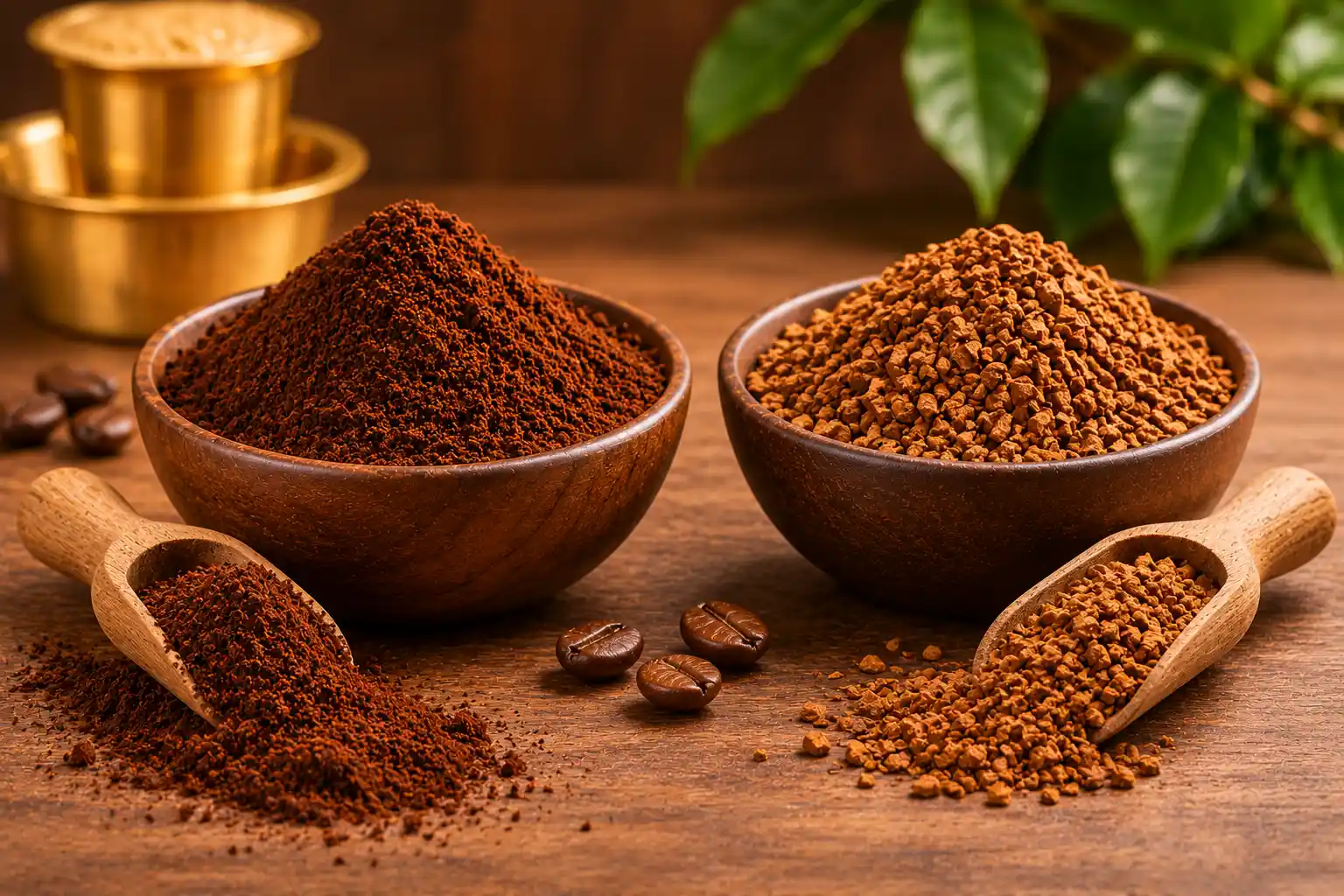
Ground filter coffee powder and instant coffee granules
Arabica and Robusta
Most filter coffee blends use both types of bean:
- Arabica: aroma and a smoother, slightly fruity taste.
- Robusta: strength and body, so the decoction holds up to milk.
You may also see Indian coffee grades on some packs:
- Plantation A: a grade of washed Arabica, prized for its clean, smooth flavour.
- Peaberry: a small, round bean that forms when a coffee cherry grows a single seed instead of two. It's often described as having a brighter, sweeter taste, and it's rarer, so it costs more.
Namma Coffee blends Plantation A, Peaberry and Robusta beans, so you get the smoothness of Plantation A, the brightness of Peaberry and the strength and body of Robusta in every cup.
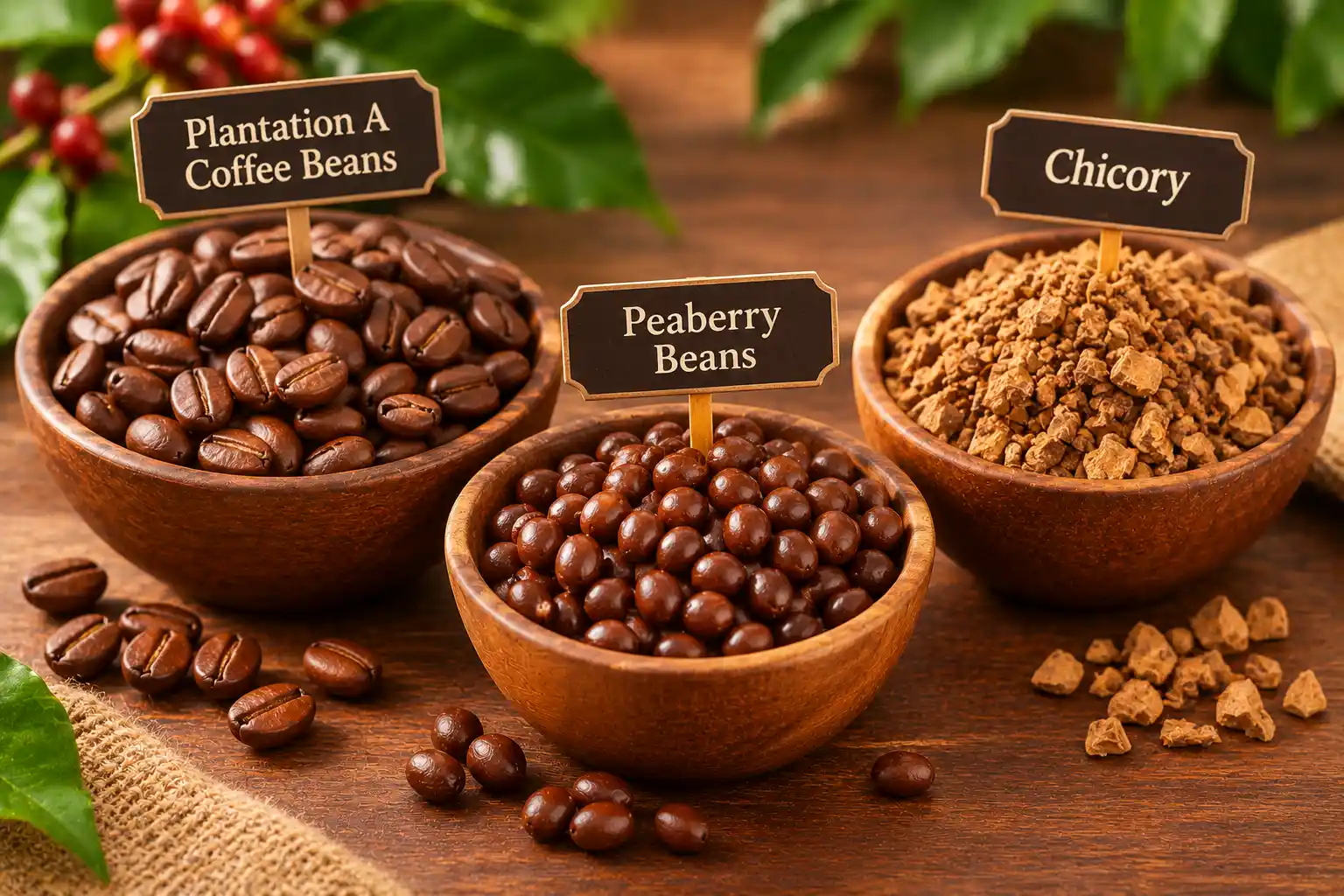
Plantation A coffee beans, peaberry beans and chicory
Roast and grind
- Roast: a medium roast suits filter coffee best. It gives a rich, dark decoction without the burnt bitterness of a very dark roast.
- Grind: filter coffee powder should be medium-fine. Too coarse and the decoction is weak. Too fine and it blocks the filter and turns bitter.
Freshness
Coffee loses aroma after it's roasted and ground. Buy powder with a recent roast date, keep it in an airtight container away from heat and moisture, and use it within a few weeks of opening. Not sure which powder to buy? See how to choose the best filter coffee powder.
How much chicory should you use?
Chicory is a roasted root that's often blended with filter coffee. It makes the decoction darker and thicker, and adds a smooth, slightly bittersweet taste. It has no caffeine, so more chicory means a milder, less caffeinated cup.
| Coffee : Chicory | Taste | Good for |
|---|---|---|
| 100 : 0 | Bold, clean coffee | Coffee lovers who want no chicory |
| 90 : 10 | Strong, with a little extra body | A strong cup with milk |
| 80 : 20 | Rich and smooth, the classic balance | Most people, and first-timers |
| 70 : 30 to 60 : 40 | Smoother, darker, milder | A lighter everyday cup |
| 50 : 50 | Mild and easy | Low caffeine, very milky coffee |
80:20 is the most popular choice and a good place to start. Our coffee-chicory ratio guide explains every ratio. Namma Coffee makes all six ratios, from the Pure Blend (100% coffee) to the Balanced Blend (50:50), with the Classic Blend at 80:20.
Some traditional home blends also mix grades, such as roughly equal parts Peaberry and Plantation A with about 10% chicory, for a brighter, fuller cup. Namma Coffee's blends combine Plantation A and Peaberry with Robusta for extra body.
Serving in a tumbler and davara
Filter coffee is traditionally served in a tumbler (a tall steel or brass cup) set inside a davara (a wide bowl with a lip), also called a dabara or dabarah. Pouring the coffee back and forth between the two does three things:
- mixes the decoction, milk and sugar evenly
- cools the coffee to a drinkable temperature
- creates the light froth that tops a good cup of kaapi
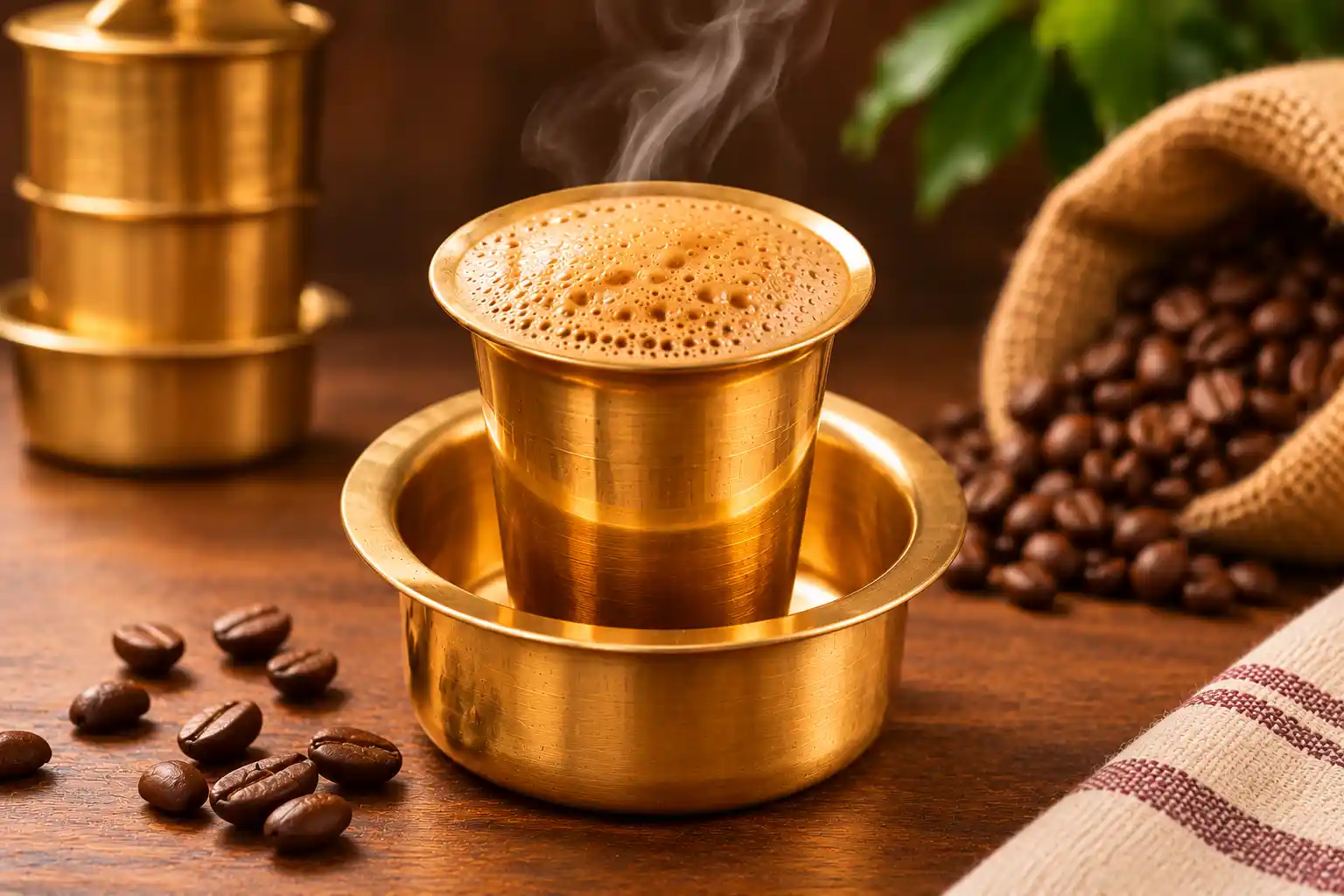
Filter coffee served in a traditional tumbler and davara
Troubleshooting: common filter coffee problems
| Problem | Likely cause | Fix |
|---|---|---|
| Weak, watery coffee | Too little powder, grind too coarse, or too much milk | Use more powder, or switch to a 1:3 decoction-to-milk ratio |
| Bitter coffee | Powder packed too hard, very dark roast, or stale powder | Press the disc lightly, and use fresh medium-roast powder |
| Decoction won't drip | Powder too fine or pressed too hard | Press more gently, and check the filter holes aren't blocked |
| No froth | Milk not hot enough, or not poured from a height | Use freshly boiled milk and pour back and forth a few more times |
| Flat, dull taste | Old powder | Buy smaller packs and store them airtight |
A short history of filter coffee
Coffee came to India in the 17th century. The story goes that the Sufi saint Baba Budan smuggled seven coffee seeds from Yemen and planted them in the hills near Chikkamagaluru, Karnataka, now called Baba Budangiri. Coffee plantations spread under British rule in the 1800s, and by the early 20th century filter coffee had become a daily ritual in South Indian homes. Read the full history of filter coffee.
Frequently asked questions
What is the ratio of decoction to milk in filter coffee?
Usually 1 part decoction to 3 or 4 parts milk. Use 1:3 for a strong cup and 1:4 for a milder one.
How many spoons of coffee powder for filter coffee?
About 3–4 tablespoons for a standard home filter. Adjust to the size of your filter and how strong you like it.
How long should filter coffee decoction drip?
15–20 minutes. Rushing it gives a weaker decoction.
Can I make filter coffee without a filter?
Yes. Line a sieve with muslin cloth, put the powder in it, and pour hot water slowly over it into a bowl. A French press also works, though the cup will be lighter.
Can I use plant-based milk?
Yes, though full-cream dairy milk gives the traditional taste and the best froth. Oat milk is the closest alternative.
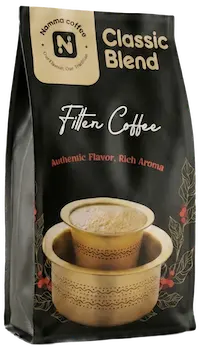
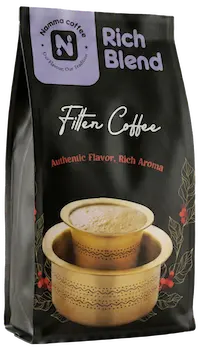
Ready to brew? Start with the Classic Blend (80% coffee, 20% chicory), the most familiar South Indian taste, or try the Rich Blend (90:10) if you like your kaapi stronger.